AskCodi
Multi-model AI coding assistant with IDE extensions for VS Code, JetBrains, Neovim, Zed, and Void. Supports 20+ LLMs including GPT-5, Claude 4.5, Gemini 2.5. 350K+ developers.
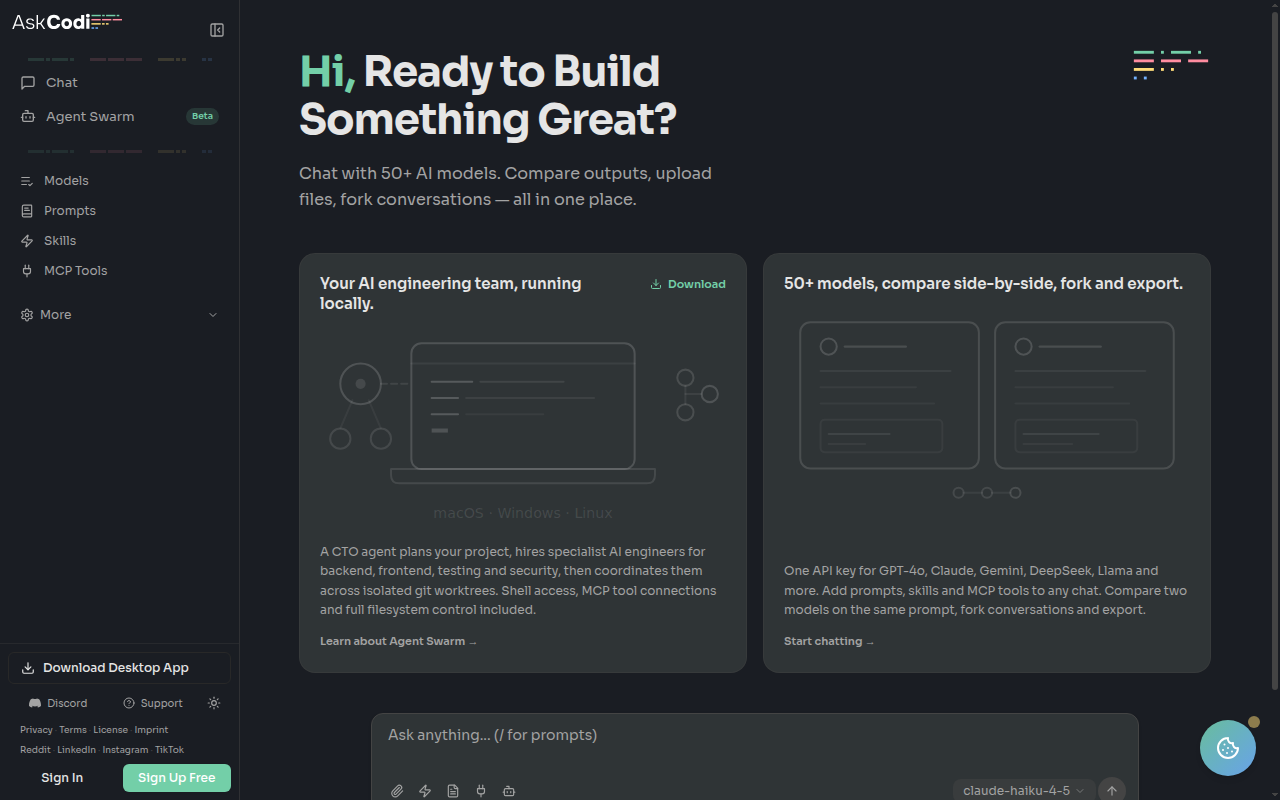
AskCodi: A Cursor Alternative for Multi-Model AI Coding Across Any IDE
AskCodi is an AI-powered coding assistant developed by Assistiv Labs, designed as a flexible IDE extension that works across VS Code, JetBrains, Neovim, Zed, and Void. Unlike single-model tools, AskCodi connects to 20+ frontier LLMs—including GPT-5, Claude 4.5 Sonnet, Gemini 2.5 Pro, DeepSeek V3.1, and Grok 4—giving developers full freedom to choose the best model for each task. With over 350,000 developers using the platform, AskCodi differentiates itself through its breadth of IDE support, multi-model flexibility, and a generous free tier that makes advanced AI coding assistance accessible without upfront cost. For teams evaluating a Cursor alternative, AskCodi is particularly compelling for polyglot environments where developers use different editors.
AskCodi vs. Cursor: Quick Comparison
| Feature | AskCodi | Cursor |
|---|---|---|
| Type | IDE Extension | Standalone AI IDE (VS Code fork) |
| Pricing | Free plan; Flexible from $25/mo | Free tier; Pro $20/mo; Business $40/user/mo |
| LLM choice | 20+ models (GPT-5, Claude 4.5, Gemini 2.5, DeepSeek, Grok, Kimi, Qwen) | Claude Sonnet, GPT-4o, Gemini (curated list) |
| Offline/local models | No (cloud-based) | No (cloud-based) |
| Open source | No | No |
| Codebase indexing | Context-aware completions | Deep codebase indexing with @codebase |
| Multi-file edits | Yes (via chat) | Yes (Composer/Agent mode) |
Key Strengths
- Widest IDE support in the market: AskCodi's extension runs natively in VS Code, JetBrains (IntelliJ, PyCharm, WebStorm, etc.), Neovim, Zed, and the Void editor. This makes it one of very few AI coding tools that doesn't require switching your development environment—a key advantage for teams with diverse tooling preferences.
- Unmatched model selection: With 20+ LLMs available including GPT-5, GPT-5.1, Claude Opus 4.1, Claude Sonnet 4, Gemini 2.5 Flash and Pro, DeepSeek V3.1, Grok 4, Kimi K2, and various Qwen models, developers can experiment and pick the right model for coding, debugging, or documentation. No other extension-based tool matches this breadth as of 2025.
- Generous free tier with no credit card required: AskCodi's free plan offers unlimited usage of free models plus 100K one-time tokens for premium models. This lowers the barrier to entry significantly for individual developers evaluating AI coding tools, and makes it viable as a no-cost daily driver for many use cases.
- Token-based flexible pricing: Unlike seat-based subscription models, AskCodi's Flexible plan starts at $25/month for 20M tokens, giving teams predictable costs that scale with actual usage rather than paying per developer regardless of utilization.
Known Weaknesses
- No deep codebase indexing: AskCodi does not offer the kind of deep project-wide semantic indexing that Cursor's @codebase feature provides. For large monorepos where context spanning thousands of files is critical, this is a notable limitation that can affect the quality of AI suggestions on complex refactoring tasks.
- No standalone IDE experience: Because AskCodi is purely an extension, it depends on the host IDE for all editing features. Cursor, as a standalone IDE fork, can optimize the entire editing experience around AI—offering tighter integration that AskCodi cannot fully replicate from an extension position.
- Cloud-only, no offline support: All AI inference is cloud-based, meaning AskCodi requires internet connectivity and sends code to external servers. Teams in air-gapped environments or with strict data residency requirements cannot use AskCodi without additional arrangements.
Best For
AskCodi is best suited for individual developers and small-to-medium teams who work across multiple IDEs and want access to the widest selection of frontier AI models without committing to a single vendor or model. It's particularly valuable for polyglot teams where some members use JetBrains IDEs, others use VS Code or Neovim, and standardizing on a single tool like Cursor would require everyone to switch editors. The free tier makes it excellent for students, open-source contributors, and cost-conscious developers who want production-grade AI assistance without a monthly subscription.
Pricing
- Free Plan: Unlimited usage of free models; 100,000 one-time premium tokens (no recurring cost, no credit card required)
- Flexible Plan: Starting at $25/month for 20M tokens; additional tokens purchasable; suitable for individual developers with higher usage needs
- Enterprise: Custom pricing, contact Assistiv Labs for volume pricing and compliance features
Pricing verified from askcodi.com/pricing as of May 2025. Prices may change; check the official site for the latest.
Technical Details
- Supported models: GPT-5, GPT-5.1, Claude 4.5 Sonnet, Claude Sonnet 4, Claude Opus 4.1, Gemini 2.5 Flash, Gemini 2.5 Pro, DeepSeek V3.1, Grok 4, Kimi K2, and multiple Qwen models (20+ total)
- Context window: Varies by model; up to 200K tokens with Claude Opus 4.1
- Platform support: VS Code, JetBrains IDEs, Neovim, Zed, Void editor, plus a web interface at askcodi.com
- Offline/local models: Not supported; cloud inference only
- Codebase indexing: Context-aware completions within open files and workspace context
- API access: Token-based API available for enterprise integrations
- Open source: No; proprietary platform by Assistiv Labs
- Languages: All major programming languages supported by the underlying models
How It Compares to Cursor
AskCodi and Cursor serve overlapping but distinct audiences. Cursor's strength is its deep integration as a full IDE—it can index entire codebases, run agents that edit multiple files simultaneously, and provide a cohesive AI-native development environment. AskCodi's strength is flexibility: it works inside whatever IDE you already use and gives access to far more LLM options than Cursor offers. For teams who are committed to JetBrains tools or Neovim and cannot migrate to a VS Code fork, AskCodi is one of the few tools that delivers comparable chat-based AI assistance without requiring an editor switch. Cursor leads on agentic multi-file editing; AskCodi leads on model choice and IDE breadth.
Conclusion
AskCodi is the right choice for developers who prioritize model flexibility and multi-IDE support over deep agentic coding features. If you work in JetBrains, Neovim, or Zed—or if you want to experiment with a wide variety of frontier models without paying per seat—AskCodi delivers strong value, especially on the free tier. Teams needing deep codebase indexing, autonomous multi-file agents, or offline operation should look at other options.
Sources
FAQ
Does AskCodi work with JetBrains IDEs like IntelliJ and PyCharm?
Yes. AskCodi provides native extensions for the full JetBrains IDE family, including IntelliJ IDEA, PyCharm, WebStorm, GoLand, Rider, and others. This is one of AskCodi's key differentiators—most AI coding tools focus exclusively on VS Code.
Can I use Claude or GPT-5 with AskCodi?
Yes. AskCodi supports 20+ models including GPT-5, GPT-5.1, Claude 4.5 Sonnet, Claude Sonnet 4, Claude Opus 4.1, and Gemini 2.5 Pro/Flash. You can switch between models based on the task at hand—using a fast, cheap model for autocomplete and a more powerful one for complex reasoning.
Is AskCodi free to use?
AskCodi has a free plan that includes unlimited access to free-tier models and 100,000 one-time premium tokens. There is no credit card required to start. Paid plans begin at $25/month for 20M tokens and offer access to all premium models.
Does AskCodi support offline or local model usage?
No. AskCodi is a cloud-based service and requires internet connectivity. All model inference happens on AskCodi's servers. Teams requiring local/offline AI coding assistance should look at tools like Continue.dev with Ollama or Tabby ML.
Reviews
No reviews yetSimilar alternatives in category

GitHub Copilot
AI pair programmer that suggests code directly in your existing IDE.

Tabnine
Privacy-focused AI code assistant with extensive IDE support and customizable models.

Qodo
Agentic code integrity platform for reviewing, testing, and writing code with AI across development workflows.