Rovo Dev
Atlassian's context-aware AI development product that connects Jira, code hosting, CLI, and VS Code workflows to plan, generate, review, and automate software delivery work.
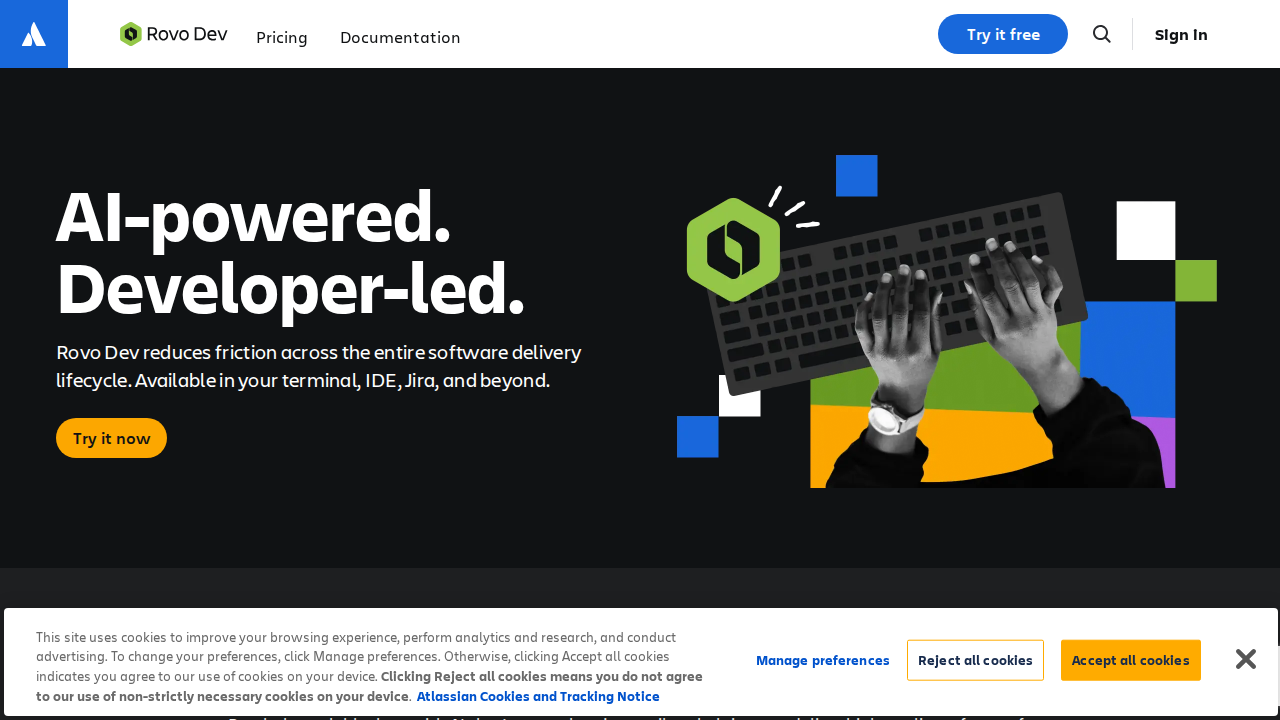
Rovo Dev: A Cursor Alternative for Jira-Centric Engineering Teams
Rovo Dev is an agentic AI development product from Atlassian. It combines coding assistance with Jira, Confluence, Bitbucket, GitHub, and IDE workflows so the agent can work with software delivery context instead of source code alone. As a Cursor alternative, it is best suited for engineering teams that already live inside the Atlassian stack and want AI tied to planning, review, and execution.
Rovo Dev vs. Cursor: Quick Comparison
| Rovo Dev | Cursor | |
|---|---|---|
| Type | CLI Agent / IDE Extension / SDLC Agent | Standalone IDE (VS Code fork) |
| Pricing | Free with Jira paid plans, or Standard at $20/user/month plus usage overages | Free / $20 / $40 per month |
| LLM choice | Atlassian-managed frontier models | Built-in models plus bring-your-own-key options |
| Offline / local models | No | No |
| Open source | No | No |
| Codebase indexing | Yes, combined with Jira and Atlassian context | Yes |
| Multi-file edits | Yes | Yes |
Key Strengths
- Built for full delivery context, not just code: Atlassian positions Rovo Dev as an AI product for the full software delivery lifecycle. That matters because the agent is meant to work with surrounding delivery signals such as Jira issues, engineering knowledge, and repository workflows, not only the files currently open in a terminal.
- Strong fit for teams already in Jira and Confluence: Rovo Dev's core advantage is not that it is a better generic coding chat than Cursor. Its advantage is that Atlassian can connect planning, requirements, issue history, and knowledge-base context directly into the development workflow, which is valuable for larger teams with process-heavy environments.
- Multiple surfaces across CLI, IDE, and platform: The official site and support materials describe Rovo Dev in CLI, IDE, Jira, automation, and code review contexts. That means it is less of a single-interface tool and more of a distributed AI layer for teams that want engineering assistance embedded across workflow stages.
Known Limitations
- Best value depends on existing Atlassian adoption: If your team does not already run heavily on Jira, Confluence, or Atlassian Cloud, a large part of the product's differentiation disappears. In that case, a cleaner terminal agent like Cursor may be easier to justify.
- Pricing is less straightforward than a simple self-serve subscription: Atlassian's public pricing language centers on Rovo Dev credits and eligible Jira Cloud plans rather than a simple standalone developer plan. That can complicate evaluation for solo developers or small teams that want instant, transparent purchasing.
Best For
Rovo Dev is best for software teams that already manage work inside Jira and want AI to understand more than the current repo state. If developers, leads, and engineering managers rely on Atlassian as the operational system of record, Rovo Dev can connect coding work to delivery goals in a way pure CLI agents usually cannot.
It is also a better fit for structured organizations than for hobbyist or highly local-first setups. Teams that care about review flows, issue hygiene, platform governance, and cross-tool visibility are closer to the audience Atlassian is targeting.
Pricing
- Rovo Dev Free: Free with eligible Jira paid plans; includes 350 Rovo Dev credits per user, per month, per site.
- Rovo Dev Standard: $20 per user per month; includes 2,000 Rovo Dev credits per user, per month across the organization.
- Overages: $0.01 per extra credit when paid extra usage is enabled.
Prices are subject to change. Check the official Atlassian billing page for current details.
Tech Details
- Type: CLI Agent / IDE Extension / SDLC Agent
- IDEs: Atlassian CLI, VS Code via Atlassian extension, plus Jira, Bitbucket, GitHub, and automation touchpoints
- Key features: context-aware coding help, software delivery lifecycle support, code review flows, Jira integration, GitHub and Bitbucket integration, Atlassian platform context
- Privacy / hosting: Cloud service built around Atlassian's platform and data intelligence layer
- Models / context window: Official materials say Rovo Dev pairs Atlassian's data intelligence layer with frontier AI models; exact model list and context window are not publicly documented on the main product page
When to Choose This Over Cursor
- Choose Rovo Dev if your engineering workflow already revolves around Jira, Confluence, and Atlassian Cloud.
- Choose it if linking coding work to delivery context, issue state, and team knowledge matters more than having a pure terminal-first agent.
- Choose it if you want AI assistance across review, automation, and platform workflows instead of only inside a local shell session.
When Cursor May Be a Better Fit
- Cursor may be a better fit if you want a lightweight tool that is easier to adopt without committing to a broader platform.
- Cursor is likely simpler for individual developers or small teams who do not need Jira-driven context or enterprise workflow coupling.
- It may also be a better option if transparent, direct model usage billing is easier for your team to evaluate than platform credits and eligibility rules.
Why Rovo Dev Is Different from Most Cursor Alternatives
Many tools in this market compete on model quality, autocomplete speed, or how agentic the editor feels. Rovo Dev competes on something else. It tries to turn software delivery context into a first-class input for AI-assisted development.
That means the product is less about being the most elegant terminal agent and more about helping engineering teams operate with shared context. Atlassian's pitch is that the agent should understand the goals, issues, workflows, and documentation around the code, not just the code itself.
For large teams, this can be a major advantage. A coding agent that understands what a Jira issue means, what related documentation exists, and where review or automation hooks live can reduce context switching in ways a standalone CLI often cannot.
How the Atlassian Context Changes the Evaluation
If your team already uses Jira to define work, Confluence to store knowledge, and Bitbucket or GitHub to host code, then Rovo Dev can sit inside a rich context graph from day one. That makes the evaluation fundamentally different from testing a standalone agent that only sees local repository state.
In practice, this can help with issue-driven implementation, review preparation, code understanding, and workflow automation. Instead of pasting tickets into a terminal or summarizing requirements manually, the platform is trying to bring that context directly into the agent's working surface.
The benefit is strongest in environments where process and coordination matter. For a solo builder moving quickly through side projects, this depth can feel like overhead. For a team shipping against structured plans and governance requirements, it can be a real advantage.
CLI and IDE Story
Rovo Dev is not only a website feature inside Atlassian products. The official materials also point to Rovo Dev CLI access through the Atlassian CLI and IDE usage through the Atlassian VS Code extension. That helps it qualify as a genuine alternative to terminal or editor-based coding agents rather than just a project management add-on.
Still, its interface story is more distributed than Cursor's. Cursor is easier to evaluate as a single product because the core identity is obvious: an AI-first editor built around one main interface. Rovo Dev spreads across more surfaces, which increases power for some teams but also increases complexity during evaluation.
That broader surface can be positive when the goal is workflow coverage. It can be negative if you want a single clean tool with minimal platform assumptions.
Pricing and Adoption Friction
One of Rovo Dev's clearest weaknesses versus Cursor is buying simplicity. Cursor has a cleaner self-serve price ladder for individual developers and small teams. Rovo Dev's public story is more platform-oriented, with credits and Jira Cloud plan eligibility shaping access.
For procurement-driven organizations, that may be perfectly normal. For individual developers or small product teams, it creates friction because the path from curiosity to active use is less direct than with tools that advertise simple public plans.
This does not make the product weak. It simply means Rovo Dev is aimed more at structured software teams than at casual evaluation or hobbyist adoption.
Where It Can Beat Cursor
Rovo Dev can beat Cursor when the hardest part of software work is not typing code, but keeping code aligned with team process and context. In those environments, Jira tickets, delivery history, review systems, and shared documentation are not side inputs. They are the actual operating environment.
Atlassian is leaning into that reality. The product is designed to make software development feel less like isolated prompt engineering and more like a connected workflow across planning, coding, and review.
If that is the problem your team is solving, Rovo Dev is more strategically differentiated than many AI editors that mainly compete on UX polish and model packaging.
Where It Falls Short
Rovo Dev is not the best choice for developers who want local-first autonomy, minimal platform dependence, or a clean bring-your-own-model story. It is also not the easiest recommendation for developers who do not use Atlassian products heavily.
That is because much of its value comes from ecosystem coupling. When the surrounding Atlassian context is weak, the tool becomes harder to justify against simpler alternatives.
It also lacks the elegant mental model of a standalone terminal agent. Some teams will value the platform reach. Others will see it as product sprawl.
Conclusion
Rovo Dev is a serious choice for organizations that want AI grounded in Jira, delivery workflows, and broader engineering context. Its strength is not minimalism. Its strength is context-rich integration across the software lifecycle.
Choose it if your team already runs on Atlassian and wants AI embedded in that operating system. Choose Cursor if you want a simpler, more portable terminal-first agent with less platform dependence.
Sources
FAQ
Is Rovo Dev free?
It does not present itself like a simple free-or-paid consumer tool. Public access is described through Jira Cloud eligibility and Rovo Dev credits, so availability depends on your Atlassian setup.
Does Rovo Dev work with VS Code?
Yes. Atlassian documents IDE access through its Visual Studio Code extension, alongside CLI and platform-based workflows.
How does Rovo Dev compare to Cursor?
Cursor is a cleaner all-in-one AI IDE, while Rovo Dev is more attractive for teams that want coding help connected to Jira, Confluence, review flows, and platform context.
Can I use Rovo Dev without Jira?
You may still access parts of the product through Atlassian's broader tooling, but the clearest public value proposition is for teams already operating inside Jira and the Atlassian ecosystem.
Reviews
No reviews yetSimilar alternatives in category

Claude Code
Terminal-first AI coding assistant for autonomous development tasks.

Aider — Cursor alternative
Aider is a leading open-source AI pair programming tool that allows you to edit code in your local git repository directly from the terminal or through various community GUIs.

Amp
An agentic coding tool engineered for outcomes, with no token constraints.