Vitara AI
Prompt-first AI app builder for product teams that want chat-based full-stack generation with downloadable code and custom-domain support.
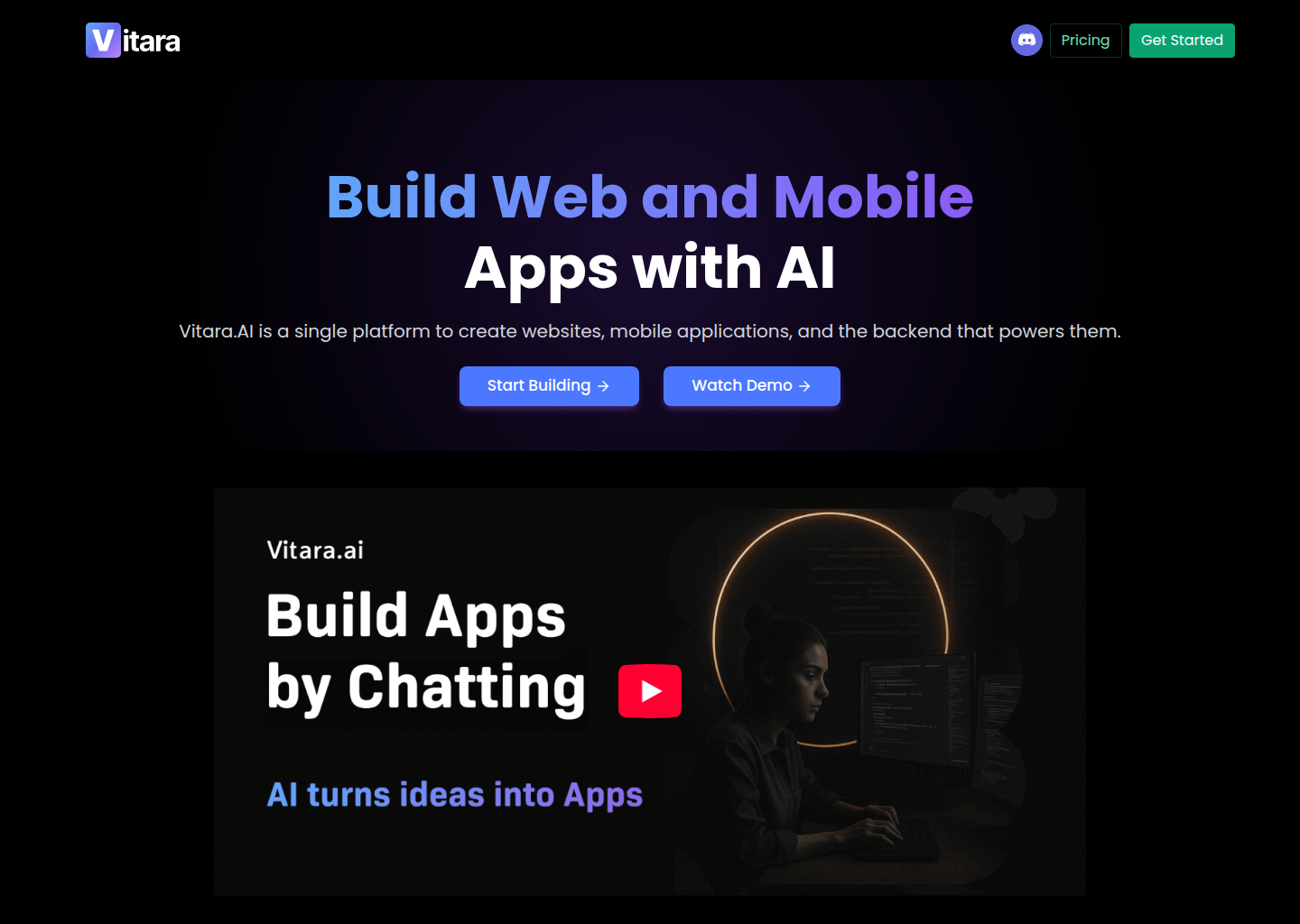
Vitara AI: A Cursor alternative for founders and product teams who want chat-led full-stack app generation with simple deployment paths
Vitara AI is a AI app builder developed by Vitara AI. It makes the browser chat workflow, previews, and deployment path the center of the experience instead of asking users to live inside an editor-first coding environment. As a Cursor alternative, it targets founders and product teams who want chat-led full-stack app generation with simple deployment paths.
Vitara AI vs. Cursor: Quick Comparison
| Tool | Cursor | |
|---|---|---|
| Type | Hosted chat-based AI app builder | Standalone IDE (VS Code fork) |
| Pricing | Free plan, then $20/month and $50/month paid tiers | Free / $20 / $40 per month |
| LLM choice | Not publicly documented in detail | Built-in models + own key |
| Offline / local models | No | No |
| Open source | No | No |
| Codebase indexing | No public indexing focus | Yes (automatic) |
| Multi-file edits | Yes, through full-stack app generation | Yes |
Key Strengths
- Clear product-builder positioning: Vitara AI explains itself in a way that is easy for product-oriented buyers to understand. It is selling a chat-led path from prompt to app, not a dense technical environment that assumes IDE habits first.
- Good balance between simplicity and ownership: Vitara is not only a disposable prototype surface. The public pricing story includes downloadable code and custom-domain support, which gives the product a more believable long-term path than platforms that never explain how you leave.
- Accessible evaluation path: A free plan with no credit card requirement lowers the barrier to honest testing. Teams can check whether the generation loop, previews, and product feel are useful before they commit to a paid workflow.
Known Weaknesses
- Less transparent technical depth: Vitara's public messaging is stronger on what the product helps you build than on how its deeper technical machinery works. Technical buyers will likely want a second validation step before betting heavily on it.
- Not designed for repository-first maintenance: Vitara is strongest when the work begins as product creation through chat. It is weaker when the main need is living inside a codebase, tracing bugs, or making disciplined multi-file edits over time.
Best For
Vitara AI is best for founders, startups, and product teams that want to compress ideation, generation, previewing, and deployment into a browser workflow. It works well when speed-to-first-product matters more than deep IDE ergonomics.
Pricing
- Free: The public pricing page says there is a free plan with no credit card required.
- Build: The same pricing page shows a Build plan at $20 per month.
- Scale: The public pricing page also shows a Scale plan at $50 per month for larger monthly usage.
Prices are subject to change. Check the official pricing page for current details.
Technical Details
- Models supported: Vitara's public messaging is stronger on what the product helps you build than on how its deeper model stack works, so exact provider and context-window details are not publicly documented on the reviewed pages.
- Context window: Not publicly documented
- IDE / platform: AI app builder
- Offline / local models: No. Vitara AI is a hosted browser builder, though paid plans include downloadable code and custom-domain features.
- Codebase indexing: No public repository-indexing story is emphasized; the product is framed around chat-led generation and previews.
- API access: No public developer API is central to the reviewed public positioning.
- Open source: No.
Workflow Fit
The workflow fit is strongest when the team needs a builder before it needs an IDE. Vitara AI moves the center of activity into a browser chat surface where app generation, previews, and deployment all sit close together, which can be valuable when the friction of getting started is more painful than the complexity of maintaining a project later.
Implementation Notes
Implementation should define whether downloadable code and custom domains are enough ownership for the current phase or whether full repository-native control is already a hard requirement. Vitara is easier to adopt when the team accepts that it is buying speed and accessibility first, then deeper engineering control later.
Migration Considerations
Moving from Cursor to Vitara AI is a workflow shift from an AI IDE toward a hosted builder. That is rational when the immediate need is getting a product surface online quickly, but it is a mismatch when the real need is staying close to an existing repository and long-lived engineering routines.
Team Adoption
Team adoption can be easier than with editor-first tools when non-terminal collaborators need to help shape the product directly. A browser chat workflow is more legible to product-minded contributors, which can shorten the path from idea to visible result before a deeper engineering handoff happens.
Governance and Cost Control
Governance questions mostly concern exportability, platform boundaries, and whether the hosted workflow aligns with the team's stage. Vitara becomes more attractive when browser-led generation is intentionally part of the operating model and less attractive when the team already knows it needs deeper technical transparency from the first day.
Decision Framework
A useful decision rule is to ask whether the team needs a builder or an IDE first. Vitara AI is stronger when the team needs a builder. Cursor is stronger when the team needs an IDE that happens to have AI capabilities layered into it.
Practical Scenarios
Strong scenarios include MVP creation, fast landing-page or internal-tool experiments, and product teams that want a visible result quickly with light deployment friction. Weaker scenarios include engineering-heavy maintenance, monorepo debugging, or buyers who already know the repository must remain the primary workspace at every stage.
Operational Tradeoffs
Operationally, Vitara AI should be evaluated against the work a team actually does every week, not against an abstract promise of AI speed. Buyers should ask whether the dominant motion is creating a new product, navigating a large repository, coordinating terminal-heavy tasks, or enabling broader collaboration around software work. The answer matters because Vitara AI is shaped around AI app builder, and that operating shape creates both leverage and friction depending on the environment.
The cost model also deserves practical scrutiny. Public pricing is clear enough to support an honest first evaluation, but the real budget impact depends on how often the team leans on the product for primary work instead of occasional acceleration. A disciplined pilot should track not only time saved, but also where the tool changes review habits, ownership expectations, and how quickly a team can recover when a generated result needs manual correction.
Adoption Questions
Before standardizing on Vitara AI, a team should decide who will own the workflow after the first impressive result. If the answer is a single founder or one advanced engineer, the tool may feel excellent in evaluation and less coherent in team rollout. If the answer is a clearly defined group with matching habits, the product has a better chance of becoming durable instead of being remembered as a short burst of novelty.
Another useful question is whether the surrounding process is ready for the product's strengths. A strong AI app builder only helps if review discipline, source-of-truth expectations, and handoff paths are already understood. Teams that align those basics early usually extract much more value than teams that hope the tool itself will compensate for unclear ownership or inconsistent engineering process.
Long-Term Fit
Long-term fit depends on whether Vitara AI remains useful after the evaluation period ends. Some AI products look strong in the first hour because they make setup disappear, but they lose appeal once teams need repeatability, clearer governance, and a predictable way to move work forward every day. The right way to assess this listing is to ask whether its strongest public advantages still matter after the novelty of generation, automation, or assisted editing wears off.
That is where context matters more than feature checklists. Teams with matching habits often get durable leverage because the tool reinforces the way they already think and work. Teams with mismatched habits usually experience the opposite: they keep the account active, but the real engineering process drifts back to more familiar tools. A serious evaluation should therefore measure behavioral fit, not only technical capability, because sustainable adoption usually follows workflow fit rather than raw demo quality.
How It Compares to Cursor
Compared with Cursor, Vitara AI trades IDE-native coding for a guided, chat-led app-building surface. Vitara AI is stronger when the primary job is quickly shipping a new product with previews and simple deployment paths. Cursor remains stronger when the team already works inside a codebase and wants AI to stay there.
Conclusion
Choose Vitara AI if browser-based product generation is the main job and downloadable code is enough ownership for the current phase. It is a stronger fit than Cursor for fast app creation, while Cursor remains the better tool for teams that already know codebase-native engineering is the operational center.
Sources
FAQ
Does Vitara AI have a free plan?
Yes. The public pricing page says there is a free plan with no credit card required.
Can you download code from Vitara AI?
Yes. Downloadable code is referenced in the paid-plan story.
How does Vitara AI compare to Cursor?
Vitara AI is better when the immediate goal is launching a new product through a browser-led workflow. Cursor is better when the immediate goal is accelerating work inside an existing codebase.
Who should skip Vitara AI?
Teams that mostly need repository-native coding, debugging, and engineering control should generally prefer Cursor instead.
Reviews
No reviews yetSimilar alternatives in category

Bolt
AI-powered web app builder that generates and deploys full-stack applications using modern frameworks.

Lovable
Build software products, using only a chat interface

Base44
No-code AI app builder that creates full-stack applications from natural language prompts.