Emergent
Full-stack AI app builder for founders and developers who want browser-based product generation, GitHub sync, and managed hosting without starting from a local IDE.
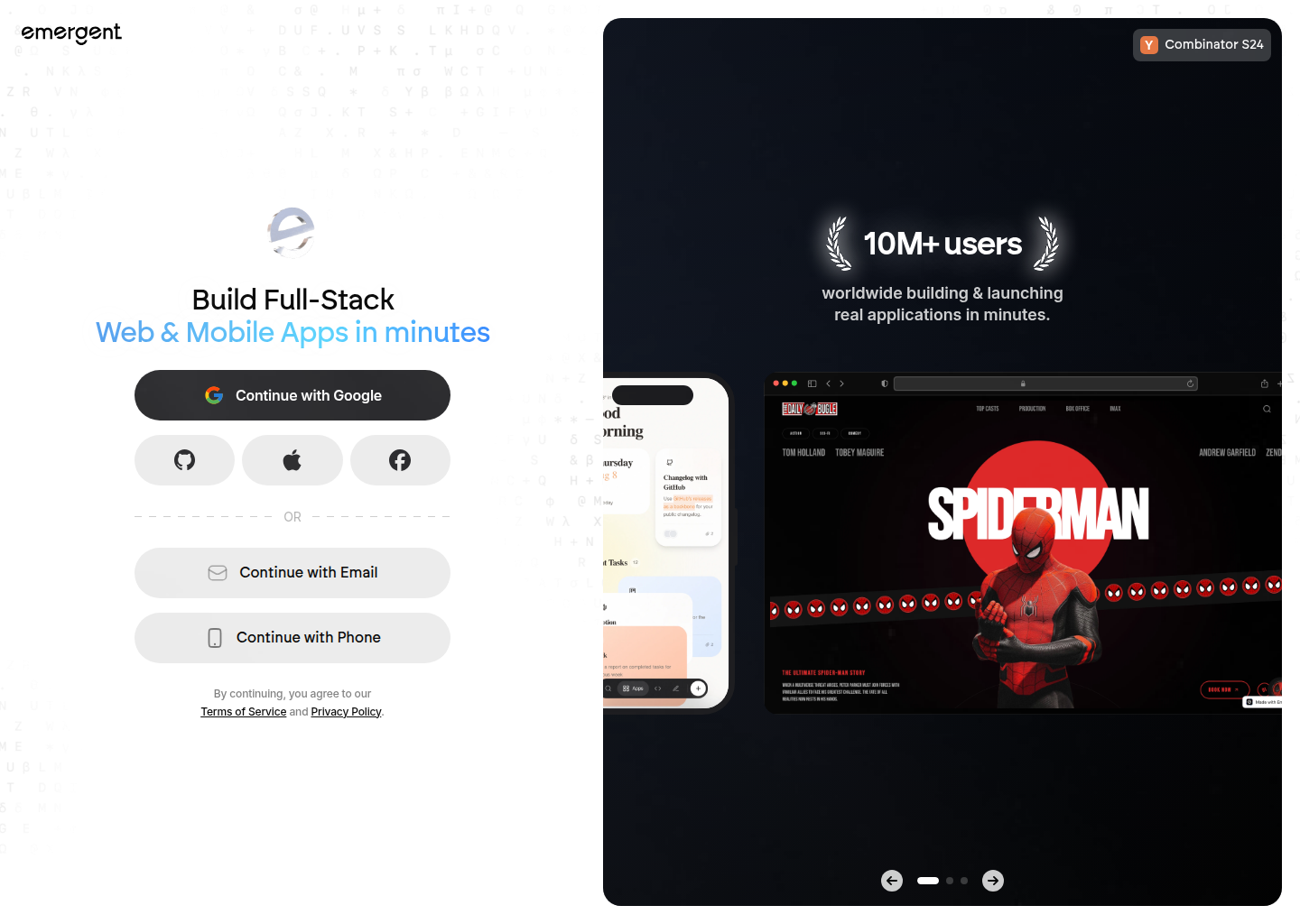
Emergent: A Cursor Alternative for founders, solo builders, and product-minded developers who want to move from prompt to hosted web or mobile app quickly
Emergent is a AI app builder developed by Emergent. It centers the workflow on browser-native full-stack generation, credit-based iteration, and managed hosting instead of asking the user to live inside a VS Code fork. As a Cursor alternative, it targets founders, solo builders, and product-minded developers who want to move from prompt to hosted web or mobile app quickly.
Emergent vs. Cursor: Quick Comparison
| Tool | Cursor | |
|---|---|---|
| Type | Browser-based AI app builder | Standalone IDE (VS Code fork) |
| Pricing | Free tier, then $20/month and up | Free / $20 / $40 per month |
| LLM choice | Managed inside the platform | Built-in models + own key |
| Offline / local models | No | No |
| Open source | No | No |
| Codebase indexing | GitHub sync, but not editor-first indexing | Yes (automatic) |
| Multi-file edits | Yes | Yes |
Key Strengths
- Fast product path: Emergent is strongest when the real goal is to get a product into a usable hosted state instead of polishing an editor workflow. The official pricing page, hosting features, and browser-first setup all point toward rapid MVP construction. For founders who care more about launch velocity than about curating a local toolchain, that is a meaningful advantage.
- Clear credit ladder: The official pricing page is unusually explicit about how the product scales from free usage to Standard and Pro. That matters because many app builders hide the practical cost of iteration behind vague credits or opaque limits. Emergent still uses a credit model, but it gives buyers a cleaner starting point for judging whether the platform matches their expected build volume.
- Built-in hosting and GitHub sync: Standard and higher plans include private hosting and GitHub integration, which makes the product more credible as a working builder instead of a demo-only toy. The workflow is not only about generating code on screen; it is also about maintaining a usable path toward deployment and ownership. That helps the tool compete with browser-native builders rather than with pure copilots.
- Works for web and mobile scope: The official pages repeatedly position Emergent as a platform for both web and mobile experiences. That broader scope is useful for teams that are still deciding the shape of a product and want one system for multiple surfaces. It will not replace every engineering workflow, but it gives non-trivial range during the validation stage.
Known Weaknesses
- Credit pressure can shape behavior: A credit-based builder changes how people experiment. Even when the monthly cost looks reasonable, the actual experience depends on how many iterations, retries, and integration passes a project needs. Teams that prefer a flatter cost model may find themselves thinking about credits sooner than they expected.
- Less engineering control than an editor-native tool: Emergent is optimized for building and shipping, not for giving developers the same repository intimacy as a deeply integrated coding IDE. That tradeoff is fine when the outcome is a fast MVP, but it can feel constraining for teams that need exact control over architecture, local tooling, or mature code review processes from the start.
Best For
Emergent is best for founders, operators, indie hackers, and practical developers who want a hosted path from prompt to app without spending the first hour wiring up a local environment. It fits especially well when the product is still being discovered, the technical stack is flexible, and the main problem is getting a credible first version online. In that context, Emergent solves a different problem than a classic AI coding IDE, and that difference is the point.
Pricing
- Free: $0 per month on the official pricing page, including 10 free monthly credits and core platform access.
- Standard: $20 per month, or $17 per month billed annually, with 100 monthly credits, private project hosting, GitHub integration, and extra credit purchases.
- Pro: $200 per month, or $167 per month billed annually, with 750 monthly credits, premium support, and larger-scale creation workflows.
Prices are subject to change. Check the official pricing pages for current details.
Technical Details
- Models supported: The official site emphasizes access to advanced models and one-click LLM integration, but it does not publish a detailed public model matrix on the reviewed pages
- Context window: Not publicly documented
- IDE / platform: AI app builder
- Offline / local models: No
- Codebase indexing: GitHub integration exists, but the product is positioned more as an app-building environment than as a repository indexer for an existing engineering codebase
- API access: No public platform API is emphasized on the reviewed public pages
- Open source: No
Workflow Fit
The workflow fit is strongest when the team wants a browser-native product studio rather than a pure assistant living inside an existing repository. You start with intent, iterate on features and screens, connect hosting and GitHub when the project becomes real, and accept the product's managed structure in exchange for speed. That makes Emergent more attractive during creation and validation than during late-stage engineering hardening.
Implementation Notes
Implementation planning for Emergent should focus on credits, hosting expectations, and where the product will hand off into a more conventional engineering lifecycle. The platform is compelling precisely because it removes early friction, but teams still need to define how much they trust the managed environment, how they review generated output, and when a project should graduate into a normal repository-driven process. Used that way, Emergent can accelerate a team without pretending to replace all engineering discipline.
Migration Considerations
Moving from Cursor to Emergent is not a like-for-like editor switch. Cursor stays close to daily coding inside an IDE, while Emergent shifts the center of gravity toward app generation, hosting, and product assembly in a browser. That is why Emergent becomes attractive when the biggest pain is building and shipping a new thing quickly, not when the biggest pain is navigating an existing codebase more efficiently.
Team Adoption
Team adoption usually works when product and engineering both need to participate early. Non-engineers can shape direction sooner, while developers can still step in through GitHub integration and later code ownership if the project proves worth hardening. That cross-functional angle is one of Emergent's real strengths, but it only works well if the team agrees on where speed ends and stricter engineering controls begin.
Governance and Cost Control
From a governance perspective, Emergent is neither lock-in free nor uniquely risky; it is simply a managed builder with strong convenience incentives. The right question is whether the hosted speed is worth the platform dependency during the stage you are in. If the answer is yes, Emergent is a rational tool. If the answer is no, an editor-native or local-first option will align better with teams that optimize for long-term control from day one.
Who Should Skip It
Emergent is a weaker fit for teams that already know their project will demand heavy infrastructure customization, strict local workflows, or repository-first review discipline immediately. It is also a weaker fit for buyers who dislike thinking in credits or who want an AI tool to augment an existing editor rather than define the whole building environment. In those cases, the product's main strength becomes a mismatch.
Decision Framework
A practical decision framework is simple: if you need a browser platform that can turn intent into a working app quickly, Emergent deserves serious attention. If you need a tool that makes a strong developer workflow inside an existing codebase even sharper, it is not aimed at the center of your problem. That distinction helps avoid judging it by the wrong standard.
Practical Scenarios
Strong scenarios include shipping a founder-led MVP, testing a new product concept with minimal setup, and creating internal tools where convenience and hosting speed matter more than bespoke engineering craft. Weaker scenarios include deeply regulated build environments, monorepos with strict local tooling, and teams that already know their product architecture before the first prompt. Emergent shines where product formation is still fluid.
Selection Verdict
Overall, Emergent is a credible pick when you want a browser-native system that can move from idea to hosted application quickly and with fewer operational decisions up front. It is not the best option for every developer workflow, but it does not need to be. For builders who value launch speed, GitHub sync, and managed hosting more than editor intimacy, the product has a strong reason to exist.
How It Compares to Cursor
Compared with Cursor, Emergent trades editor-centric coding assistance for a fuller prompt-to-product workflow. Emergent is stronger when the task is building and shipping a new app with hosting and browser-native iteration. Cursor remains stronger for developers who already live inside a codebase and want a fast, repo-aware assistant inside an IDE.
Conclusion
Choose Emergent if your main objective is turning ideas into hosted products quickly with a builder that already includes deployment-minded features. It is a stronger fit than Cursor for browser-first app creation, while Cursor remains the better tool for engineering teams centered on an editor workflow.
Sources
FAQ
Is Emergent free?
Yes. The official pricing page includes a free plan with 10 monthly credits, while higher tiers add more credits, hosting, and integrations.
Does Emergent include GitHub integration?
Yes. The official Standard plan includes GitHub integration, which helps teams move from prompt-based generation toward repository-backed ownership.
How does Emergent compare to Cursor?
Emergent is better when the job is building and hosting a new app quickly in a browser workflow. Cursor is better when the job is accelerating development inside an editor and an existing codebase.
Who should use Emergent?
It is best suited to founders, solo builders, and product-minded developers who need a fast route from concept to working web or mobile app.
Reviews
No reviews yetSimilar alternatives in category

Bolt
AI-powered web app builder that generates and deploys full-stack applications using modern frameworks.

Lovable
Build software products, using only a chat interface

Base44
No-code AI app builder that creates full-stack applications from natural language prompts.