
Rocket.new (formerly DhiWise)
AI-powered platform that converts prompts and Figma designs into production-ready web and mobile applications. Formerly DhiWise, rebranded to Rocket.new in 2025.
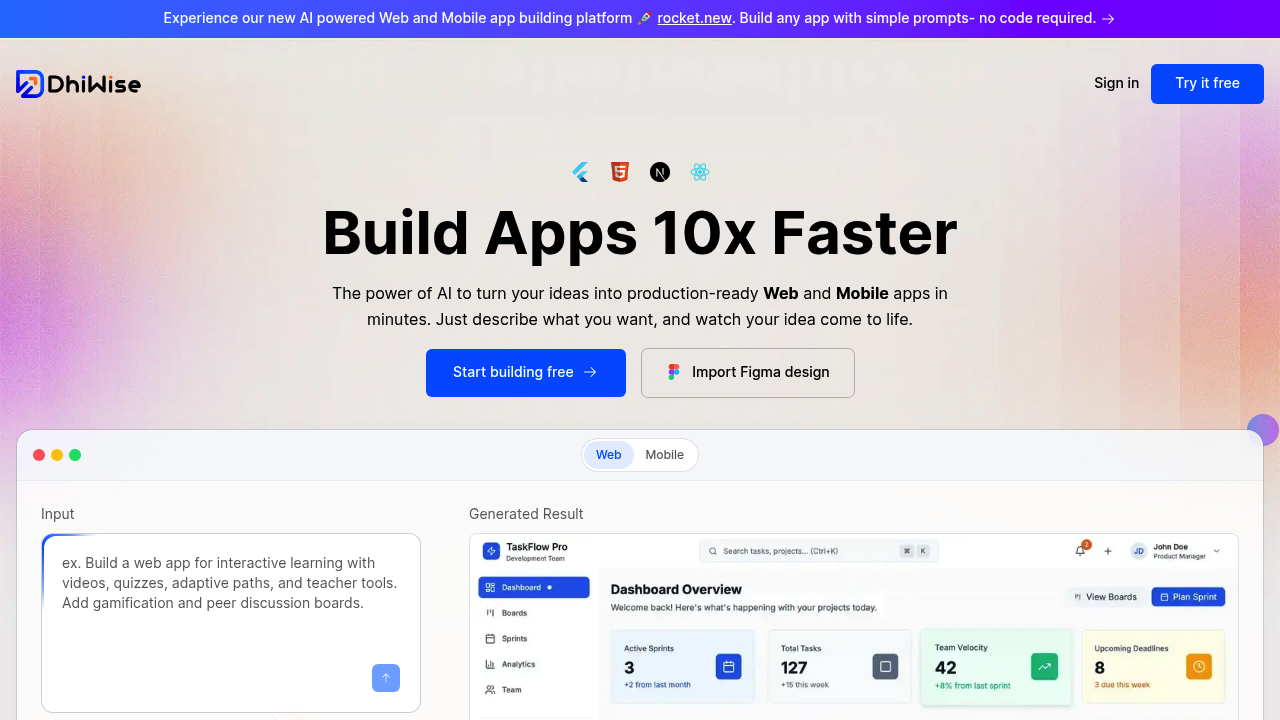
Rocket.new (formerly DhiWise) — Cursor alternative
Note: DhiWise rebranded to Rocket.new in 2025. The dhiwise.com domain now redirects to rocket.new. Existing DhiWise accounts remain accessible, and users can switch between the classic DhiWise interface and the new Rocket.new platform.
Rocket.new is an AI-powered app builder that transforms natural language prompts into full-stack, production-ready web and mobile applications. Describe your idea once and get a working app — with frontend, backend logic, database schema, authentication, and deployment setup generated automatically. Unlike tools that require prompting page by page, Rocket.new generates the complete application from a single description. The platform supports Flutter for mobile and Next.js for web, and includes a 25,000+ template library to reduce token usage. Rocket.new raised $15 million in September 2025.
Strengths
- Converts a plain-text description into a complete full-stack app — frontend, backend, integrations, and deployment in one pass.
- Figma-to-code conversion transforms visual mockups into responsive, production-ready code.
- Supports Flutter (mobile) and Next.js (web) with clean, exportable code that developers can continue working with.
- 25,000+ template library cuts token consumption by up to 80% and speeds up builds significantly.
- Unlimited team members on every paid plan — no per-seat fees.
- Credits never expire.
- Built-in visual editor for UI adjustments without rewriting prompts or editing code.
- Available on web, iOS, and Android.
Weaknesses
- Not designed for ongoing manual code editing inside the platform — best for generating a starting codebase, not iterative day-to-day development.
- Credit-based pricing model can be hard to predict for complex, multi-iteration projects.
- Less suitable for developers who need granular control over every architectural decision from the start.
- Free plan credits are limited to public projects.
Best for
Non-technical founders, indie developers, and small teams who need to go from idea to deployed application quickly — especially for MVPs, internal tools, dashboards, and mobile apps.
Pricing plans
- Free — $0/month — 5 credits/day, public projects, unlimited collaborators
- Build — $20/month — 100 monthly credits, custom domains, hosting included, version control, mobile app support, 25+ integrations, unlimited team members
- Personal — $25/month — increased credit allocation for solo builders with heavier usage
- Booster — Higher tier — for teams needing larger monthly credit volumes
- Enterprise — Custom pricing — custom limits, dedicated support, advanced security
Credits do not expire. All paid plans include unlimited team members with no per-seat fees.
Tech details
- Type: AI-powered full-stack app builder
- IDEs: Web-based platform; code export available for use in any IDE
- Key features: Natural language to full-stack app, Figma import, Flutter + Next.js output, visual UI editor, built-in deployment, database schema generation, 25,000+ templates
- Privacy / hosting: Cloud-hosted; full code export and ownership on all paid plans
- Models / context window: Proprietary AI stack; specific models not publicly disclosed
When to choose this over Cursor
- You need to generate an entire application from a description rather than assist with writing code inside an editor.
- You want to convert a Figma design into a functional Flutter or Next.js app without writing boilerplate.
- Speed to MVP matters more than granular code control from day one.
When Cursor may be a better fit
- You are working on an existing codebase that needs iterative AI-assisted editing.
- You need inline autocomplete and chat assistance throughout the development process.
- You prefer traditional coding workflows with full architectural control.
Conclusion
Rocket.new (formerly DhiWise) occupies a different part of the development workflow compared to editor-based AI tools like Cursor. Where Cursor helps you write code faster inside an IDE, Rocket.new generates the entire application from your description and gets you to a deployable state without any manual coding. The two tools are complementary: Rocket.new to scaffold and launch, Cursor or a traditional IDE to iterate and maintain.
Sources
Reviews
No reviews yetSimilar alternatives in category

Bolt
AI-powered web app builder that generates and deploys full-stack applications using modern frameworks.

Lovable
Build software products, using only a chat interface

Base44
No-code AI app builder that creates full-stack applications from natural language prompts.