Refact.ai
Refact.ai is an open-source AI coding agent developed by Small Magellanic Cloud AI Ltd. It provides autonomous code editing, in-IDE chat, and real-time autocompletion via VS Code and JetBrains extensions, with optional self-hosted deployment on your own infrastructure. As a Cursor alternative, it targets developers and teams who need data privacy, self-hosting control, or local model support.
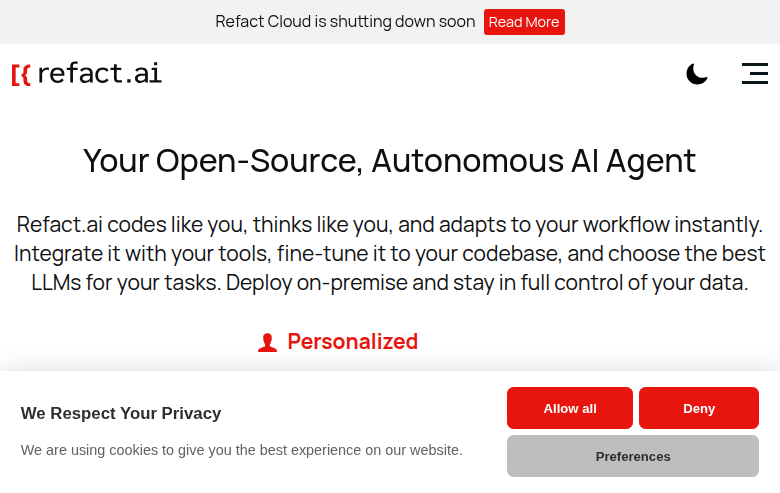
Refact.ai: An Open-Source Cursor Alternative for Self-Hosting Developers
Refact.ai is an open-source AI coding agent developed by Small Magellanic Cloud AI Ltd. It provides autonomous code editing, in-IDE chat, and real-time autocompletion via VS Code and JetBrains extensions, with optional self-hosted deployment on your own infrastructure. As a Cursor alternative, it targets developers and teams who need data privacy, self-hosting control, or local model support — use cases Cursor does not address.
Refact.ai vs. Cursor: Quick Comparison
| Refact.ai | Cursor | |
|---|---|---|
| Type | VS Code + JetBrains extension + self-hosted CLI agent | Standalone IDE (VS Code fork) |
| Pricing | Free tier; Pro $10/month; Enterprise: custom self-hosted | Free / $20 / $40 per month |
| LLM choice | Multiple (OpenAI, Anthropic, local models via Ollama); fine-tune on your codebase | Built-in models + own key |
| Offline / local models | Yes — Ollama, Qwen2.5-Coder, custom fine-tunes | No |
| Open source | Yes — Apache 2.0 (client and server) | No |
| Codebase indexing | Yes — RAG-based vector database, per-project | Yes (automatic) |
| Multi-file edits | Yes — autonomous agent mode | Yes |
| Self-hosting | Yes — on-premise deployment available | No |
Key Strengths
- Open-source with self-hosting: The Refact.ai server and client are fully open-source under Apache 2.0, available at github.com/smallcloudai/refact. Teams with strict data residency requirements can run the entire stack on-premise — no data leaves the network. This is a hard requirement for regulated industries where Cursor's cloud-only model is not an option.
- Autonomous coding agent: Refact.ai Agent delegates multi-step coding tasks end-to-end. It plans, executes, and deploys: analyzing repositories via RAG, connecting to GitHub, databases, and CI/CD pipelines, and operating step-by-step with previews so developers can review and control each stage. The agent runs inside the IDE without switching contexts.
- Local model support with RAG-enhanced completions: Refact.ai ships with Qwen2.5-Coder for fast local autocompletions, using retrieval-augmented generation to pull project-specific context at inference time. Developers can also connect OpenAI, Anthropic, or any Ollama-compatible model — and even fine-tune a model on their own codebase through the Refact enterprise offering.
- In-IDE chat and code editing: The chat panel inside VS Code and JetBrains IDEs allows natural language code generation, bug fixes, and refactoring with full context awareness. Unlike standalone LLM chat, Refact.ai reads open files, symbols, and project structure to generate accurate, project-specific responses.
- Community benchmark recognition: Refact.ai claims the #1 spot on SWE-bench among open-source AI agents, which covers multi-step software engineering tasks on real GitHub issues. This benchmark provides an independent signal of autonomous task completion quality versus proprietary tools.
Known Weaknesses
- Coin-based pricing adds unpredictability: The free and Pro tiers use a coin system ($1 = 1,000 coins) rather than flat monthly requests. Heavy agentic usage burns through coins quickly, and the cost per task depends on the underlying model choice. Unlike Cursor's fixed monthly request bundles, costs can be harder to predict for teams running the autonomous agent frequently.
- Self-hosting requires infrastructure overhead: On-premise deployment gives data control but requires a working Docker or server environment, GPU access for local models, and ongoing maintenance. Teams without DevOps capacity will find the setup overhead significant compared to Cursor's zero-infrastructure experience.
- Smaller ecosystem and community: Refact.ai has a smaller user base and fewer community-created extensions, templates, and workflows compared to Cursor. Documentation is solid but the third-party ecosystem is limited, which can slow adoption in larger engineering organizations.
Best For
Refact.ai is the right Cursor alternative for developers and teams who need on-premise data control, local model execution, or open-source transparency. It fits regulated industries (finance, healthcare, defense) where cloud-based AI coding tools fail compliance requirements, solo developers running local Ollama-based setups, and engineering teams that want to fine-tune a model on their own codebase. If data privacy is a non-negotiable requirement and Cursor's cloud-only model is disqualifying, Refact.ai is the strongest open-source alternative.
Pricing
- Free: 2,000 coins/month for AI Agent and Chat; unlimited fast autocompletions powered by Qwen2.5-Coder; in-IDE chat; codebase-aware vector database
- Pro: $10/month — 10,000 coins renewed monthly; "Thinking" model access; all Free features; additional coins purchasable at $1 = 1,000 coins
- Self-Hosted / Enterprise: Custom pricing — on-premise deployment, zero telemetry, model fine-tuning on your codebase, SSO, dedicated support
Prices are subject to change. Check the official pricing page for current details.
Technical Details
- Models supported: Qwen2.5-Coder (local, for completions), OpenAI GPT series, Anthropic Claude, any Ollama-compatible model; custom fine-tunes via Enterprise
- Context window: Varies by model; RAG retrieval supplements context with project-specific data
- IDE / platform: VS Code extension + JetBrains extension (IntelliJ, PyCharm, WebStorm, etc.) + self-hosted server CLI
- Offline / local models: Yes — full Ollama support, runs entirely on-premise
- Codebase indexing: Yes — RAG-based vector database built per-project, analyzes repository symbols and files
- API access: Yes — server is open-source and self-hosted; REST API available for enterprise integrations
- Open source: Yes — Apache 2.0 license; client and server code at github.com/smallcloudai/refact
- Self-hosting: Yes — Docker-based on-premise server; GPU recommended for local model inference
How It Compares to Cursor
Cursor is a polished IDE with deep AI integration, but it requires all code to pass through Cursor's cloud infrastructure — there is no on-premise option. Refact.ai fills the self-hosting gap: same autonomous agent capabilities (multi-file edits, codebase context, step-by-step execution), with the option to run everything locally. Cursor's Pro plan is $20/month with fixed request limits; Refact.ai's Pro is $10/month with a coin system, which is cheaper for moderate usage but less predictable at scale. Cursor has better UI polish and a larger ecosystem; Refact.ai has open-source transparency and local model support. Teams choosing between them are essentially choosing between convenience (Cursor) and data control (Refact.ai).
Conclusion
Refact.ai is the leading open-source Cursor alternative for developers who need data sovereignty, on-premise deployment, or local model execution. At $10/month Pro or free for light usage, it competes directly with Cursor on autonomous coding capabilities while offering what Cursor cannot: a self-hosted, fully open-source option that never sends code to a third-party cloud.
Sources
FAQ
Is Refact.ai free?
Yes. Refact.ai has a free tier that includes 2,000 coins per month for AI Agent and chat use, plus unlimited fast code autocompletions powered by Qwen2.5-Coder. The Pro plan costs $10/month and adds 10,000 coins and thinking model access.
Does Refact.ai work with VS Code?
Yes. Refact.ai has a native VS Code extension available in the VS Code Marketplace. It also supports JetBrains IDEs including IntelliJ IDEA, PyCharm, WebStorm, and GoLand.
How does Refact.ai compare to Cursor?
Both offer multi-file AI editing and autonomous agents, but Cursor is a standalone IDE (VS Code fork) without self-hosting, while Refact.ai is a VS Code/JetBrains extension with an optional self-hosted server. Refact.ai is open-source and supports local models; Cursor routes all requests through its cloud infrastructure. Cursor is more polished; Refact.ai gives more data control.
Can Refact.ai run local models offline?
Yes. Refact.ai supports Ollama-compatible local models and runs entirely on-premise when self-hosted. You can use Qwen2.5-Coder locally for autocompletions with zero network calls. The self-hosted server also supports custom fine-tuned models trained on your own codebase.
Reviews
No reviews yetSimilar alternatives in category

GitHub Copilot
AI pair programmer that suggests code directly in your existing IDE.

Tabnine
Privacy-focused AI code assistant with extensive IDE support and customizable models.

Qodo
Agentic code integrity platform for reviewing, testing, and writing code with AI across development workflows.