Grit
Open-source CLI tool for declarative code search and transformation using GritQL query language. Automates large-scale code migrations, custom linting, and API upgrades across 80+ million lines of code.
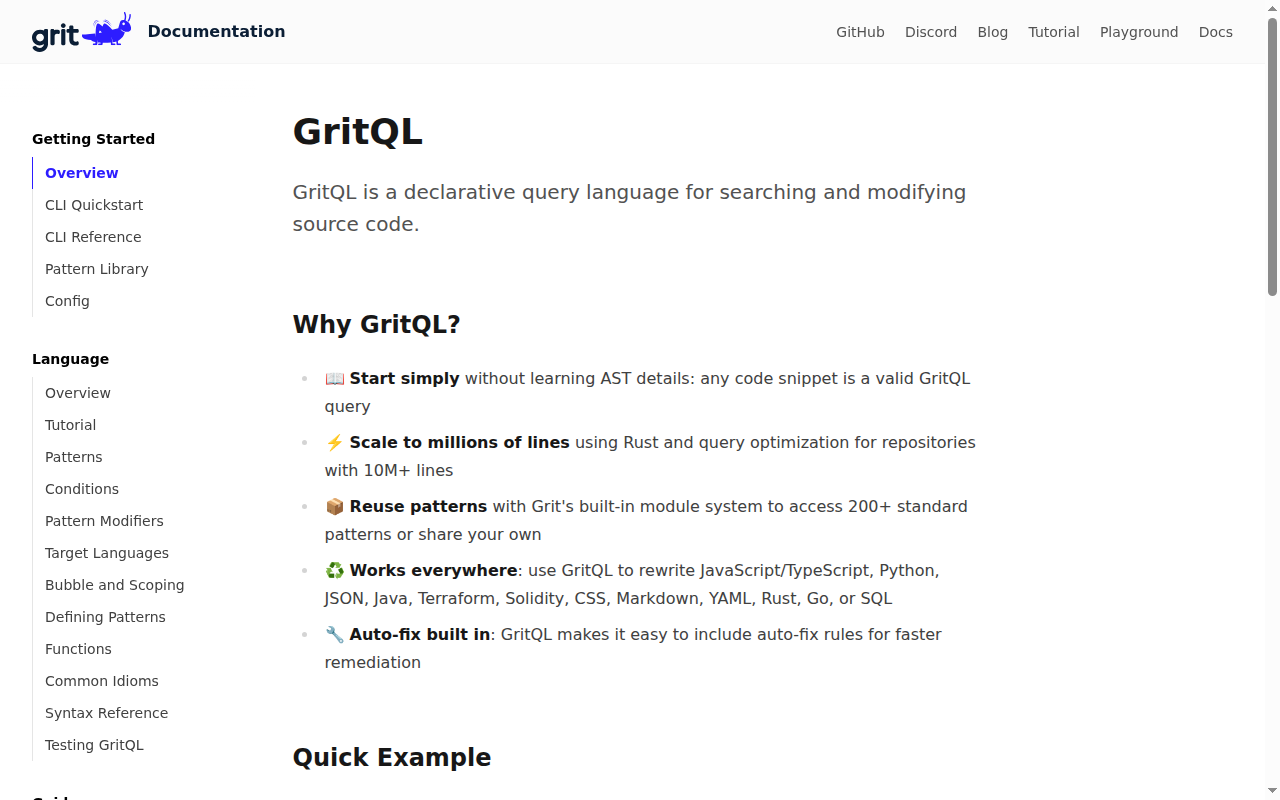
Grit: A Cursor Alternative for Automated Large-Scale Code Migrations via CLI
Grit is an open-source CLI tool developed by Grit.io (backed by Y Combinator) that enables developers to search, transform, and migrate code at scale using GritQL—a declarative pattern-matching query language built on top of Tree-sitter. Unlike AI pair programmers that assist with interactive coding sessions, Grit is purpose-built for automated, repeatable code transformations: migrating APIs across entire codebases, enforcing custom lint rules, or upgrading frameworks without touching individual files one by one. With over 4,500 GitHub stars and documented use across 80+ million lines of code, Grit addresses the class of developer workflow problems that conversational AI tools handle poorly—systematic, large-scale changes that must be applied consistently across thousands of files. For engineering teams that frequently upgrade dependencies, enforce architectural patterns, or perform systematic refactors, Grit offers a fundamentally different approach from interactive editors like Cursor.
Grit vs. Cursor: Quick Comparison
| Feature | Grit | Cursor |
|---|---|---|
| Type | CLI tool / code transformation engine | Standalone AI IDE (VS Code fork) |
| Pricing | Open-source CLI: free; Cloud/SaaS: contact for enterprise | Free tier; Pro $20/mo; Business $40/user/mo |
| LLM choice | Pattern-based (no LLM required); LLMs for AI-powered migrations in cloud | Claude Sonnet, GPT-4o, Gemini (curated) |
| Offline/local models | Yes (local CLI mode works fully offline) | No |
| Open source | Yes (GritQL MIT licensed, 4,500+ GitHub stars) | No |
| Codebase indexing | AST-based pattern matching across entire codebase | Semantic vector indexing |
| Multi-file edits | Yes (batch transformations across thousands of files) | Yes (Composer/Agent mode, interactive) |
Key Strengths
- Declarative, reproducible code transformations: GritQL lets you write a pattern once and apply it to an entire codebase deterministically. Unlike LLM-based tools where results can vary between runs, Grit's AST-based transformations produce the same output every time, making them suitable for CI/CD pipelines and automated migration scripts that need to be reviewed and merged like any other code change.
- Massive scale without LLM costs: Grit's pattern-based engine can process millions of lines of code without any API calls or token costs. For common migration tasks—renaming APIs, updating import paths, changing function signatures—this is significantly faster and cheaper than using an LLM to edit files one at a time. The company has documented transformations across 80+ million lines of code in production environments.
- Fully offline local mode: The Grit CLI is a self-contained Rust binary that runs entirely locally. No API keys, no internet connectivity required, no code sent to external servers. This makes Grit viable for enterprise environments with strict data security requirements where cloud-based AI tools cannot be used.
- Open-source with a growing library of migrations: The GritQL repository includes pre-built migration patterns for popular frameworks and libraries. The community contributes patterns for React upgrades, Node.js API changes, TypeScript migrations, and more—reducing the time to write custom transformations from scratch.
Known Weaknesses
- Steep learning curve for GritQL: Writing effective GritQL patterns requires understanding Tree-sitter AST concepts and the GritQL syntax, which is a separate skill from the programming languages being transformed. For developers unfamiliar with AST manipulation, there is a meaningful ramp-up period before Grit becomes productive. Interactive AI tools like Cursor have zero learning curve by comparison.
- Not suitable for interactive development: Grit is a migration and transformation tool, not an interactive coding assistant. It cannot answer questions, explain code, generate new features from descriptions, or provide autocomplete suggestions. Teams need both Grit (for systematic transformations) and a separate tool for day-to-day interactive AI assistance.
- Enterprise cloud pricing is opaque: While the open-source CLI is free, the cloud SaaS offering that adds LLM-powered migration suggestions and team collaboration features does not publish pricing publicly. Teams evaluating Grit for enterprise use need to contact the company for quotes.
Best For
Grit is ideal for platform engineering teams, developer experience (DevEx) engineers, and senior developers responsible for large-scale codebase migrations and technical debt reduction. It excels when a team needs to apply the same code transformation consistently across hundreds or thousands of files—upgrading a deprecated API, enforcing a new coding convention, or migrating from one framework version to another. Organizations with strict data security policies that prohibit sending code to cloud AI services will also find Grit valuable as an offline-capable automation tool that requires no external API access.
Pricing
- Open-source CLI: Free forever. GritQL is MIT licensed; the CLI can be downloaded and used without any account or payment.
- Cloud/SaaS (app.grit.io): Pricing not publicly listed; contact Grit for enterprise and team pricing information.
Pricing verified from grit.io and the GritQL GitHub repository as of May 2025. Check official sources for current pricing.
Technical Details
- Core technology: GritQL query language built on Tree-sitter AST parsing; Rust-based CLI
- Supported languages: JavaScript, TypeScript, Python, Ruby, Go, Java, Terraform, CSS, HTML, JSON, YAML, and more via Tree-sitter grammars
- Platform: CLI (Rust binary for macOS, Linux, Windows); VS Code extension available; cloud at app.grit.io
- Offline support: Yes — full local execution, no internet required for CLI mode
- Open source: Yes — GritQL MIT licensed at github.com/getgrit/gritql (4,500+ stars)
- LLM integration: Optional — cloud/SaaS mode can use LLMs for generating migration patterns; local mode is LLM-free
- CI/CD integration: Designed for scripting; can be integrated into GitHub Actions, GitLab CI, and other pipelines
- API access: Via cloud platform; local CLI is self-contained
How It Compares to Cursor
Grit and Cursor occupy complementary but non-overlapping roles in a developer's toolkit. Cursor is an interactive AI IDE built for the moment-to-moment experience of writing and editing code with AI assistance. Grit is an automation tool for systematic, repeatable code transformations at scale—the kind of work that would take days to do manually in Cursor even with AI help. A mature engineering team might use both: Cursor for daily interactive development and Grit for quarterly migration tasks or continuous architecture enforcement in CI. The tools are not direct competitors; they address fundamentally different workflows.
Conclusion
Grit is the right choice for teams that need reproducible, large-scale code transformations that go far beyond what interactive AI editors can offer efficiently. If your team regularly performs framework upgrades, API migrations, or architectural refactors across large codebases—and you want a deterministic, offline-capable, open-source solution—Grit's GritQL provides a uniquely powerful approach. Individual developers writing features day-to-day should pair Grit with an interactive AI tool for complete coverage.
Sources
FAQ
What is GritQL and how is it different from regular regex search-and-replace?
GritQL is a declarative query language that operates on Abstract Syntax Trees (ASTs) rather than raw text. Unlike regex, GritQL understands code structure—it can match function calls with specific argument patterns, find imports of particular modules, or identify class methods with certain decorators, all in a syntax-aware way that doesn't break on whitespace variations or comment placement. This makes GritQL transformations dramatically more reliable than regex for code migrations.
Can Grit be used in CI/CD pipelines?
Yes. The Grit CLI is designed to be scriptable and can be integrated into GitHub Actions, GitLab CI, Jenkins, and other CI/CD systems. You can run Grit checks as part of your pipeline to enforce coding standards or automatically apply migrations as part of a release process.
Does Grit require an internet connection?
The Grit CLI runs entirely locally and requires no internet connection. All pattern matching is done on your machine using the local Tree-sitter parser. The cloud platform (app.grit.io) and LLM-powered features do require connectivity, but these are optional additions to the core open-source tool.
What programming languages does Grit support?
Grit supports JavaScript, TypeScript, Python, Ruby, Go, Java, Terraform HCL, CSS, HTML, JSON, YAML, and additional languages via Tree-sitter grammar plugins. The language support continues to expand as the open-source community contributes new grammars.
Reviews
No reviews yetSimilar alternatives in category

Claude Code
Terminal-first AI coding assistant for autonomous development tasks.

Aider — Cursor alternative
Aider is a leading open-source AI pair programming tool that allows you to edit code in your local git repository directly from the terminal or through various community GUIs.

Amp
An agentic coding tool engineered for outcomes, with no token constraints.